I get this question a lot. Someone finds one of those “$29.99, get certified in 60 minutes” ads online, buys the course, prints the certificate, and then wonders why nobody’s calling them back.
It’s a fair question. Forklift work is steady, it pays decently, and you don’t need a college degree to do it. So the appeal of a fast online shortcut makes sense. The problem is that most of those ads don’t tell you the full story.
Let me break it down the way I would for someone sitting across from me in a training room.
What OSHA Actually Requires for Forklift Operators
This is the piece most online providers gloss over, so let’s start here.
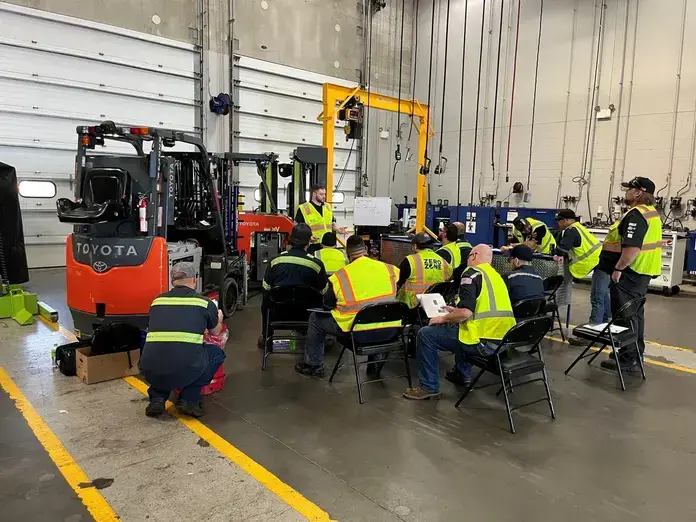
OSHA’s Standard 1910.178(l) governs forklift operator training. The rule requires two things: formal training and a hands-on evaluation. That evaluation must be done in person, by a qualified trainer, on the actual type of equipment you’ll be operating, at the actual worksite where you’ll be working.
Not a similar machine. Not a video walkthrough. The real thing, in your real environment, with someone qualified watching you operate it.
Here’s how to keep the terms straight:
- A certificate from an online course confirms you completed a training program.
- OSHA-compliant certification means you’ve done the classroom training and passed a hands-on performance evaluation.
- Until you’ve done both, you’re not cleared to operate a forklift unsupervised at any OSHA-covered workplace.
When an online course claims to make you “fully OSHA certified,” that’s not accurate. The regulation doesn’t allow the performance evaluation to happen online. Some providers know this and say it anyway. Others genuinely don’t understand the rule. Either way, don’t take their word for it.
So What Does an Online Forklift Certificate Actually Give You?Honestly? More than nothing, but less than most people expect.
A solid online course covers the knowledge side of forklift training: equipment types (counterbalance, reach truck, order picker, pallet jack), load capacity and center of gravity, pre-operation inspection procedures, and the OSHA regulations you’re expected to know as an operator.
That’s real, useful information. I’ve seen plenty of candidates walk into interviews with zero prep, and it shows. If you can explain the stability triangle, describe what you check during a pre-shift inspection, or talk about why load capacity changes with mast tilt, you immediately stand out from people who show up with nothing.
It also helps when employers run their own onboarding evaluation, which OSHA requires them to do before putting you on equipment. If you already know the fundamentals, you’re spending that time practicing on the machine instead of sitting through a basics review.
What it won’t do is put you in the operator’s seat on day one. The certificate shows you studied. It doesn’t show you can safely move a 5,000-pound load down a narrow aisle without clipping a rack. Those are different things, and any experienced employer knows that.
How Employers Actually View Online Forklift Certificates
| What Employers Want | Importance | Why It Matters |
|---|---|---|
| 🎓 Online Forklift Training Certificate | ⭐⭐⭐⭐☆ Preferred | Demonstrates you’ve completed forklift safety training and understand OSHA requirements. |
| 🏗️ Hands-On Performance Evaluation | ⭐⭐⭐⭐⭐ Required | Employers must evaluate your ability to operate a forklift safely before authorizing you to work. |
| 🦺 Safety-First Attitude | ⭐⭐⭐⭐⭐ Essential | Employers value operators who consistently follow safety procedures and help prevent workplace accidents. |
| ⏰ Reliability & Attendance | ⭐⭐⭐⭐⭐ Essential | Being dependable and punctual is critical in warehouse and industrial environments. |
| 💼 Previous Forklift Experience | ⭐⭐☆☆☆ Helpful | Experience is an advantage, but many employers are willing to train motivated entry-level applicants. |
This is usually where reality sets in.
Large distribution centers and logistics companies with active safety programs understand OSHA’s requirements. They’re not going to accept an online-only certificate as proof that you’re ready to operate. What they’re looking for is documented seat time and a clean record. The certificate might get a small nod, but it’s not moving your application to the top of the pile.
Smaller operations are a different story. A regional warehouse, a local building supply company, a mid-size manufacturer. These employers often don’t have a dedicated safety manager, and some will look at your online cert as a genuine positive. Many will do a quick in-person evaluation themselves before putting you on equipment, which technically satisfies the OSHA requirement on their end. For those employers, the certificate holds more value.
Staffing agencies are worth understanding separately. They’re one of the most common entry points into forklift work, and most of the good ones run their own hands-on training. They may appreciate that you took an online course before showing up, but you’ll still go through their process. That’s a good thing. It means you get proper training, and you get placed.
Here’s the bottom line from a hiring perspective: nothing on paper replaces actual machine time. Employers who know this industry are looking for operators with real hours and no incidents. That’s the credential that opens doors.
When an Online Certificate Can Still Help Your Job Search
So should you bother? In certain situations, yes.
If you’re new to the industry and have no warehouse background, completing an online course before you apply shows initiative. It tells a hiring manager you took the job seriously enough to prepare, rather than walking in hoping for the best. For entry-level roles where employers plan to train new hires anyway, that signal carries more weight than you’d think.
The training also prepares you for the interview itself. Screening questions for forklift roles are often practical: What equipment have you operated? What’s on your pre-shift checklist? What would you do if you spotted a hydraulic fluid leak before your shift? Those aren’t trick questions. They’re checking whether you have a basic foundation. If you’ve done an online course, you can answer them.
Some employers also split the training process deliberately. They want candidates to complete the classroom portion independently, so the first day on site goes straight to hands-on evaluation. If you see a job posting that says “must complete online safety training prior to start,” your certificate fits directly into that workflow.
The Better Path: How to Actually Get Hired as a Forklift Operator
If your goal is to get hired and get on a machine, here’s what actually works.
Staffing and temp agencies are the fastest route for people starting from scratch. Industrial staffing firms know local employers, often run their own forklift training, and can place you relatively quickly. You may start as a temp, but plenty of those placements turn into permanent jobs, especially if you show up on time and work safely.
Entry-level warehouse roles take longer but build a stronger foundation. Many large warehouses hire general floor workers and cross-train high performers on powered equipment. You earn the certification on the job, and you leave with a reference from an employer who watched you do the work.
Community colleges and trade schools are an option worth looking into. Most metro areas have programs that combine classroom training and in-person evaluation in a single course, sometimes completed in a day or two. That’s a complete, OSHA-compliant credential. Costs vary, but workforce development programs sometimes offer these at low or no cost.
Union apprenticeship programs in construction, shipping, or manufacturing often include forklift certification as part of broader skills training. If those industries interest you, it’s worth checking what’s available in your area.
Employer-sponsored training is more common than people realize. Many large logistics operations are always hiring, and they post it openly. Look for listings that say “will train” or “no forklift experience required.” That’s not a throwaway line. It means they have a structured onboarding process and they’re willing to put the time in if you are.
Common Forklift Job Types
| Position | Certificate Value | Experience | Hiring Difficulty |
|---|---|---|---|
| Warehouse Associate | ⭐⭐⭐⭐☆ Helpful | None | 🟢 Easy |
| Material Handler | ⭐⭐⭐⭐☆ Helpful | None | 🟢 Easy |
| Shipping & Receiving Clerk | ⭐⭐⭐⭐☆ Helpful | None | 🟢 Easy |
| Forklift Operator | ⭐⭐⭐⭐⭐ Important | Sometimes | 🟡 Moderate |
| Distribution Center Operator | ⭐⭐⭐⭐⭐ Important | Sometimes | 🟡 Moderate |
| Manufacturing Forklift Operator | ⭐⭐⭐⭐⭐ Important | Often | 🔴 Competitive |
💡 Good News for Beginners: Many employers hire Warehouse Associates, Material Handlers, and Shipping & Receiving Clerks with no previous forklift experience. Completing an online forklift training course can help you stand out and may increase your chances of getting hired for these entry-level positions.
Red Flags to Watch Out For
A few things to keep in mind as you’re shopping for courses.
If a course promises you’ll be “fully OSHA certified” by the end of an online module, that’s not accurate. OSHA doesn’t allow the performance evaluation to happen remotely. Providers who use that language are either misinformed or banking on you not knowing the difference.
Price doesn’t equal quality here. Some courses charge $100 or more for the same classroom material you can find for $20, or sometimes free through a local workforce program. The legal standing of the certificate is the same regardless of what you paid. Don’t spend more than you need to.
Watch how you describe the certificate on your resume. Writing “forklift certified” without context can create problems. A safety manager or experienced HR person will recognize that online-only doesn’t satisfy OSHA’s evaluation requirement, and it raises questions. A cleaner way to phrase it: “Completed forklift safety training, classroom component; hands-on evaluation pending.” That’s accurate, it shows you understand the process, and it tends to read better to people who know what they’re looking at.
The Honest Bottom Line
An online forklift certificate won’t get you hired by itself. But used the right way, it’s not a waste of time.
It gives you the foundational knowledge to interview better, onboard faster, and show employers you’ve put in some effort before walking through the door. What it can’t do is replace the hands-on evaluation OSHA requires, or stand in for actual operating experience.
The real credential in this field is time on a machine with a clean safety record behind it. That’s what experienced employers are looking for. An online course can be a reasonable first step, but pair it with something that gets you in front of real equipment: a staffing agency, an entry-level warehouse job, or a community college program that includes a hands-on component.
The demand for qualified forklift operators is steady and growing, driven by e-commerce and domestic manufacturing. Employers are hiring. Many will train the right person from the ground up.
Know what the certificate can and can’t do. Use it where it helps. Then focus on getting real seat time as quickly as you can. That’s the path that actually leads somewhere.
Leave a Reply